Dropped where we said, when we said
A roll-off dumpster in Charlotte, NC is the fastest way to move demo debris off a lawn you are proud of and into a container that leaves on a date you already know. Most people searching for a dumpster rental near me in Charlotte are one night out from demo day or one morning past a storm, so we answer the phone, ask about the driveway and the street, and give a ballpark before anyone commits. Call (980) 353-3063, or text photos of the drive and the pile and we will tell you what fits.
Tell us your project and timeline — we'll recommend the right size.
A firm, all-in price confirmed before we start — no surprises.
Dropped where you want it, then picked up or swapped when you're done.
Reach a real Charlotte dumpster rental technician to describe the problem — no call-center runaround.
We look at the actual system and explain what is going on before any work.
You get the price for the fix up front and decide before we proceed.
Serving Charlotte and the surrounding area — confirm coverage by phone.
The 10-yard roll-off is our small-footprint container, roughly 11 to 12 feet long with low walls, and it holds about 3 pickup loads of debris. Low walls matter when you are pitching heavy material over the side by hand — a bathroom gut, a tile floor, a small deck, one garage bay. It fits single-lane driveways in Elizabeth, Chantilly and older Plaza Midwood blocks where a longer box would block the sidewalk or the neighbor's approach. Typical included weight allowance runs 1 to 2 tons, stated on your quote before delivery. Ballpark $295–$425 for a 3- to 7-day rental in Charlotte.
The 15-yard roll-off is the size most Charlotte homeowners actually need and rarely ask for: about 14 feet long, roughly 50 percent more capacity than a 10-yard, and still short enough for most two-car driveways in Cotswold, Madison Park and Steele Creek. It is the right box for a kitchen plus flooring, a two-room plaster-and-lath demo in a 1940s house, or a full garage and attic clear-out. The extra volume matters when you would otherwise be triaging what to leave behind on the last day. Typical allowance around 2 tons. Ballpark $345–$495 in Charlotte.
The 20-yard roll-off is the most-requested container in Charlotte because it absorbs a single-layer shingle tear-off on most 1,800–2,400 sq ft roofs and still leaves one lane of a two-car drive open for a trade truck. Roughly 16 feet of container length, about 6 pickup loads of volume. Feature that matters: the wall height is still low enough to load drywall and trim by hand without a ramp, which is why mixed remodels — cabinets, subfloor, doors, insulation — go smoothest in a 20. Typical allowance near 3 tons. Ballpark $395–$575 for a 3- to 7-day rental.
The 30-yard roll-off is the bulky-light-debris box: whole-home cleanouts, framing scrap, sectional sofas, carpet and pad, ductwork, siding. Tall walls give you roughly 9 to 10 pickup loads of volume, which is why it wins on furniture and lumber and loses on rubble. It needs about 22 feet of straight, level run plus overhead clearance, so a low willow oak limb or a tight Dilworth apron can rule it out — we check the approach before we schedule it. Typical allowance around 4 tons. Ballpark $495–$695 in Charlotte.
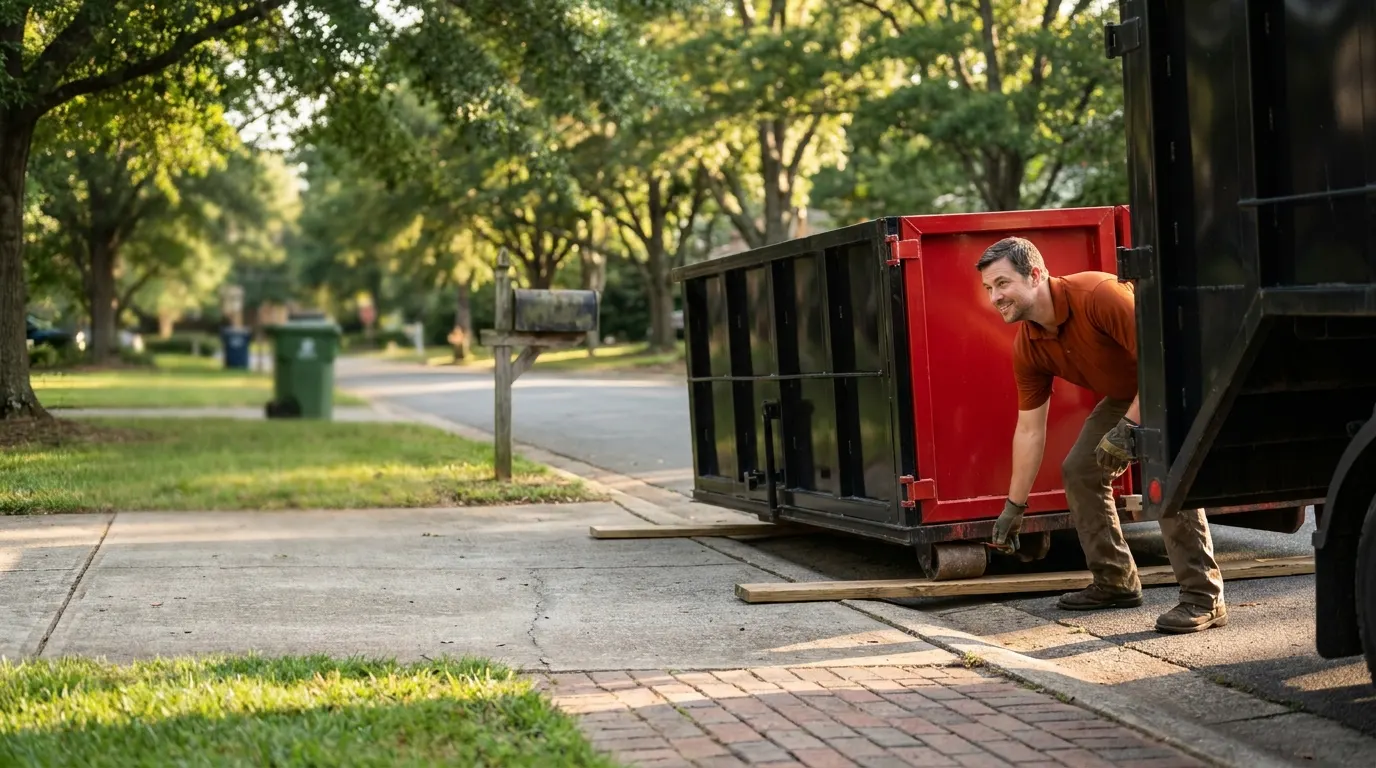
Residential dumpster rental in Charlotte is placement work as much as hauling work. Before the truck comes we ask three questions: how wide is the street, what is the driveway made of, and what is hanging over the approach. Boards go under the rails on every driveway drop, the container stays off brick paver aprons wherever the geometry allows, and after the pull the apron gets a magnet sweep so nails do not end up in a tire. That is the driveway reveal we care about: container gone, boards picked up, concrete clean. Homeowners in Dilworth, Elizabeth, Myers Park, Cotswold and Sedgefield are the core of this work.
Construction and demolition dumpster rental covers mixed job-site debris — framing lumber, drywall, subfloor, trim, doors, windows, cabinets, siding and insulation — hauled to a permitted disposal facility. Sorting matters to your invoice: a box of clean wood or clean rubble is a different weight and disposal category than a mixed load, so keeping rubble out of a C&D box is the single easiest way to hold your price. We size to the phase, not the whole project: a 20-yard for demo week, a 30-yard for framing scrap. Ask about placement on tight infill lots in South End and Optimist Park before delivery day.
Shingle dumpsters are placed for tear-offs, and placement is the whole job. Asphalt shingles are heavy for their volume — a single layer off a typical Charlotte ranch or 1.5-story roof usually fits a 20-yard, and two or three layers often means a 30-yard or a mid-job swap-out. We set the box close to the drip edge so the crew is not walking bundles across a lawn, then magnet-sweep the drive and apron after the pull because roofing nails are the number one thing left behind. Late summer through early fall is the busy window ahead of hurricane-remnant rain, so reserve about a week ahead.
Clean-fill dumpster rental is a weight service, not a volume service. Concrete, brick, block, pavers, dirt and asphalt go in a dedicated 10-yard box loaded only to the marked fill line, which is why a patio removal in Ballantyne or a walkway tear-out in Steele Creek costs less in a small box than in a big one you cannot legally fill. Keep it clean — no wood, no dirt-clumped roots, no trash mixed in — and the load is priced as clean fill instead of general debris. Ballpark $325–$475 in Charlotte, confirmed once we know the square footage and thickness.
Storm-debris boxes handle limbs, brush, leaves, stumps and fence sections after summer thunderstorms and winter ice events, and they are the container Charlotte suddenly needs in the same week. Charlotte's mature willow oaks drop heavy limbs inside I-277 and through Freedom Park's surrounding blocks, and green wood is much heavier than it looks, so wet brush is often better in a 10 or 15 than a 30. Cut limbs to fit rather than ramping one long piece across the top — an overhanging load cannot be legally hauled. Same-week availability tightens fast after a storm, so call early.
Same-day dumpster delivery in Charlotte happens when a truck and an empty container are both open, and the honest cutoff is before mid-morning. If we cannot do it today, we say next-day instead of stringing you along, because a vague window is what stalls a demo crew. Either way you get a delivery window rather than 'sometime that day,' and a call if anything moves. Same-day is most realistic in January and February, and least realistic during the spring peak and the week after a storm. Call (980) 353-3063 and we will tell you what today actually looks like.
A swap-out is an empty container dropped as the full one leaves, on the same trip, so a crew never stops loading. It is the right call on multi-layer roof tear-offs, whole-home renovations, and turnover work where debris outpaces one box. Two things make swaps go smoothly: leave the truck a straight approach, and keep the load level with the top rail so the container can be tarped and hauled legally. Ballpark $250–$495 per swap depending on size and debris type. Contractors running back-to-back jobs in Ballantyne, University City and South End usually schedule swaps in advance.
Long-term dumpster rental fits projects that run on weekends instead of a two-day sprint — a basement in Sedgefield, a garage in University City, a slow kitchen remodel where cabinets leave in stages. Extra days run a ballpark $10–$20 per day past the included rental period, which is far less than paying for a second delivery and pickup. For renovation and turnover crews we set standing terms so the box stays put through multiple phases and gets swapped on a schedule you choose. Tell us how you actually work and we will price the term around it rather than around a default 7 days.
Size is a debris-volume decision first and a driveway decision second, and in Charlotte the driveway usually wins the argument. If you are gutting one bathroom, clearing a single garage bay, or tearing off a small back deck, choose the 10-yard: it occupies roughly 11 to 12 feet of length, tucks behind a parked car on a one-lane Elizabeth or Chantilly drive, and holds about 3 pickup loads. If you are pulling a kitchen plus flooring, or emptying two rooms of plaster and lath out of a 1940s house in Cotswold or Plaza Midwood, choose the 15-yard — roughly 14 feet long, about 50 percent more room than the 10, so you stop debating what to leave behind.
5-story roofs while keeping one lane of a two-car drive open for the trade truck. If you are clearing a whole house, framing an addition, or hauling bulky light debris like sectionals, carpet, ductwork and lumber, choose the 30-yard — but only if you have about 22 feet of straight, level run and no low limb over the approach. The trade-off is consistent and worth saying plainly: bigger boxes cost more and eat more driveway, while a box that is too small forces a swap-out you did not budget for, and a swap costs more than sizing up once at the start.
Heavy debris flips the whole logic. Concrete, brick, block, dirt and asphalt are priced by weight rather than by space, so if you are removing a patio in Ballantyne or a front walkway in Steele Creek, take a 10-yard dedicated clean-fill box and load it to the marked fill line instead of a 20-yard you can only fill a third of the way. If your pile is mixed household debris with a little rubble tossed in, say so before delivery — rubble mixed into a general-debris box gets weighed as general debris, and that is where surprise overage charges come from.
Access decides the rest. If your street is wide enough for a truck to back straight in and the drive is clear, a driveway drop is almost always the right call: nothing to coordinate, you load at your own pace, and the box sits inside your property line. If you only have alley access behind NoDa or Optimist Park, or your Dilworth frontage sits under a heavy willow oak canopy, the answer is a site look before we commit to a date — sometimes the box goes in the alley, sometimes it goes at the curb, and sometimes a 10 or 15 replaces the 20 you asked for because the shorter truck reach is the only thing that works.
The trade-off there is capacity for certainty, and certainty is usually worth more when a demo crew is already scheduled. Rental length works the same way. If you are doing a hard two-day demo with a crew, a short 3-day rental is the cheapest path.
If you are a homeowner chipping away nights and weekends on a garage in University City or a basement in Sedgefield, take the 7-day or ask about a longer term — extra days cost far less than a second delivery. If you run remodel, roofing or turnover work across Ballantyne, South End and Steele Creek, a standing account with scheduled swap-outs beats calling in each time, because your crew never stands around waiting on a box. The one decision we will not make from a phone call is whether your old concrete drive with a brick paver apron will mark.
Old Charlotte concrete over red clay flexes, and pavers set in sand can shift under a loaded box no matter how carefully it is placed. We lay boards under the rails, we keep the container off the apron when the geometry allows, and if the geometry does not allow it we say that out loud before the truck rolls instead of after.
| Service call | Upfront quote |
Call for a firm, all-in price before any work begins.
We give an upfront, written price before any work begins — you approve it first. No surprises.
Our work is done to standard and we stand behind it — a real fix, not a quick patch.
We’ll give you an honest assessment. If you don’t need the work, we’ll tell you.